US Passport Photo Requirements 2026: Rules, Mistakes & At-Home Tips
Last Update: June 13, 2026
This guide explains the key US passport photo rules for 2026, including background, facial expression, clothing, glasses, children’s photos, editing, and common rejection reasons. If you already know the rules and only need the exact crop or printable 2 x 2 inch layout, use our US passport photo size tool.
Quick Summary of US Passport Photo Requirements
Here is a quick overview of the main US passport photo rules. For exact crop, print layout, and output settings, use our US passport photo size tool.
Requirement: Photo size
Rule: 2 x 2 inches for printed photos
Requirement: Background
Rule: Plain white or off-white
Requirement: Expression
Rule: Neutral expression or natural smile, eyes open
Requirement: Glasses
Rule: Not allowed except for documented medical reasons
Requirement: Photo age
Rule: Taken within the last 6 months
Requirement: Editing
Rule: No filters, retouching, AI edits, or digital changes
US Passport Photo Background Rules
The background is where most people go wrong with passport photos. The US passport photo background must be clean and neutral so nothing distracts from your face.
Use a plain white or off-white background with no patterns, textures, or decorations. Make sure there are no shadows, objects, or people visible, and avoid anything like furniture or scenery in the frame.
Keeping the background simple is one of the easiest ways to follow US passport photo requirements.
Standing too close to the background can create dark shadows, especially when using indoor lighting or a phone flash. For best results, stand a short distance away from the wall and use soft, even lighting.
US Passport Photo Size and Head Position
For printed passport photos, the required size is 2 x 2 inches, or 51 x 51 mm. Your head should be centered in the frame and measure between 1 inch and 1 3/8 inches from the bottom of the chin to the top of the head.
Your full face must be visible, and your head and shoulders should be properly centered. Avoid photos where your face is too close, too far away, cropped, tilted, or off-center. Even if the background and lighting are correct, poor head position can still cause the photo to be rejected.
For exact cropping and printable layout, use our US passport size photo tool.
Facial Expression and Head Position
Your face should point directly toward the camera. Keep your head straight and avoid turning, tilting, or looking away. Your eyes should be open and clearly visible.
A neutral expression is usually the safest choice. A natural, relaxed smile may also be acceptable, but avoid exaggerated expressions, squinting, raised eyebrows, or an open mouth. The goal is to show a clear and natural image of your face without distractions.
Lighting and Image Quality
Good lighting is essential for an acceptable passport photo. Your photo should be clear, sharp, in color, and evenly lit. Avoid blurry, grainy, dark, overexposed, or pixelated images.
Use soft light from the front or both sides of your face. Natural daylight can work well if it is not too harsh. Avoid strong shadows on your face, under your chin, or behind your head. Also check for glare, red-eye, reflections, and color changes caused by poor indoor lighting.
If you are printing the photo, use photo-quality paper. Do not submit photocopies, damaged photos, creased photos, or photos with visible printer dots.
What to Wear for a US Passport Photo
Wear normal, everyday clothing for your passport photo. Simple clothing usually works best because the focus should stay on your face. Avoid uniforms, camouflage clothing, costumes, or clothing that looks like a uniform.
It is also better to avoid white or very light-colored tops, because they may blend into the white or off-white background. A darker everyday shirt usually gives clearer separation between your shoulders and the background.
Religious clothing that you wear daily is generally acceptable, as long as your full face is visible. Large jewelry, hats, and accessories should be removed if they distract from your face or create shadows.
Glasses and Head Coverings
Glasses are not allowed in most US passport photos. This rule helps prevent glare, reflections, and anything that may block the eyes. If you must wear glasses for a medical reason, you may need a signed statement from a doctor or medical professional.
Sunglasses and tinted glasses should not be worn. Your eyes must be clearly visible.
Head coverings are only allowed for religious or medical reasons. Your full face must be visible from the bottom of the chin to the top of the forehead. The covering should not cast shadows or hide any part of your face.
US Passport Photo Rules for Babies and Children
Taking a passport photo for a baby or young child can be difficult, but the same basic rules still apply. The child should be the only person in the photo, with no parent, guardian, hands, toys, pacifiers, or other objects visible in the frame.
For babies, you can place the child on a plain white or off-white sheet or blanket and take the photo from above. Make sure the baby’s face is visible and not covered by shadows. Try to keep the eyes open and the face directed toward the camera as much as possible.
For older children, have the child sit or stand in front of a plain background and look directly at the camera. Avoid playful expressions, turned heads, and objects in the child’s hands.
Photo Age and Editing Rules
Your passport photo should be recent and show your current appearance. In most cases, it must have been taken within the last 6 months. If your appearance has changed significantly, such as after major facial changes, a new photo may be needed.
Do not use filters, beauty retouching, AI tools, or editing software that changes your appearance. You should not smooth skin, change eye color, remove facial features, alter the face shape, or replace the background in a way that changes the natural outline of your head, face, or neck.
Basic cropping and resizing are acceptable when used only to meet the required photo format. The photo itself should remain natural and unchanged.
Common Reasons Passport Photos Get Rejected
Many passport application delays happen because the submitted photo does not meet official standards. Before submitting your photo, check for these common problems:
- The photo is not 2 x 2 inches for printed submission.
- The head is too large, too small, off-center, or partly cropped.
- The background is not plain white or off-white.
- There are shadows on the face or background.
- The photo is blurry, grainy, dark, overexposed, or low quality.
- The applicant is wearing glasses without a valid medical reason.
- The face is tilted, turned, or not looking directly at the camera.
- The expression is exaggerated or the eyes are not clearly open.
- The photo has been digitally edited, filtered, retouched, or altered by AI.
- Another person, object, toy, hand, or pacifier appears in a child’s photo.
Checking these issues before submission can reduce the chance of rejection and help your passport application move forward more smoothly.
How to Take a Passport Photo at Home
You do not need a professional studio to take a passport photo. With a simple setup, you can take a compliant photo at home.
Stand or sit in front of a plain white or off-white wall. Use soft, even lighting and place the camera at eye level. Keep your head straight, look directly at the camera, and keep your eyes open. Ask someone else to take the photo if possible, or use a tripod to keep the camera steady.
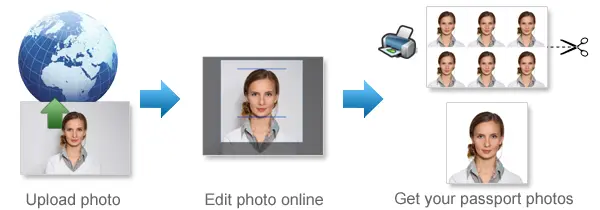
After taking the photo, review it carefully. Make sure the image is sharp, the background is clean, the lighting is even, and your face is centered. Then upload the photo to our online US passport photo tool to crop and size it correctly.
US Passport Photo Requirements FAQ
Can I wear glasses in a US passport photo?
No. Glasses are not allowed in most US passport photos. They are only accepted in rare medical cases, and you may need a signed statement from a doctor or medical professional.
Can I smile in a US passport photo?
A neutral expression is the safest choice. A natural, relaxed smile may be acceptable, but your eyes should be open and your face should look directly at the camera. Avoid exaggerated expressions or an open mouth.
Can I take a US passport photo at home?
Yes. You can take a US passport photo at home if you use a plain white or off-white background, even lighting, a clear image, and correct head position. After taking the photo, use a passport photo tool to crop and size it correctly.
Can I edit my passport photo?
You should not use filters, beauty retouching, AI tools, or software edits that change your appearance. Basic cropping and resizing are acceptable, but the image should remain natural and unchanged.
What is the most common reason passport photos are rejected?
Common reasons include incorrect size, poor lighting, shadows, blurry image quality, glasses, busy backgrounds, head position problems, and digital editing.
Do baby passport photos follow the same rules?
Yes, the same basic rules apply. The baby should be the only person in the photo, with a plain background and no visible hands, toys, pacifiers, or other objects. The rules may be slightly more flexible for infants, but the face should still be clear and visible.
Conclusion
Meeting US passport photo requirements is easier when you focus on the key details: correct size, plain background, even lighting, clear face position, no glasses, and no digital editing. A careful photo can help you avoid rejection, save time, and reduce delays in your passport application.
If you want to prepare your photo online, upload your image to our US passport photo size tool to crop and format it for passport use.
This document is rated 4.8 / 5 - 2 Votes