Understanding Passport Photo Head Position Rules: A Practical Guide
Last Update: January 20, 2026
A passport photo is a small image with big importance. Governments use it to verify identity, that is why every detail must meet official standards. Among all the requirements, correct head position is one of the most critical. Many passport photo rejections happen simply because the head was not positioned properly.
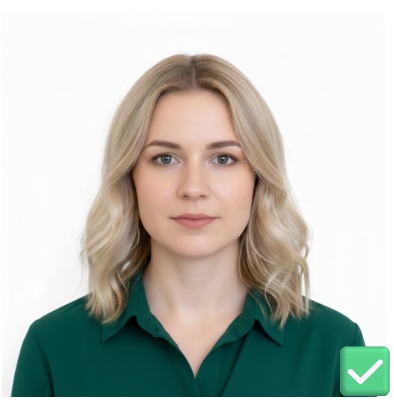
The Core Rule: Face the Camera Straight On
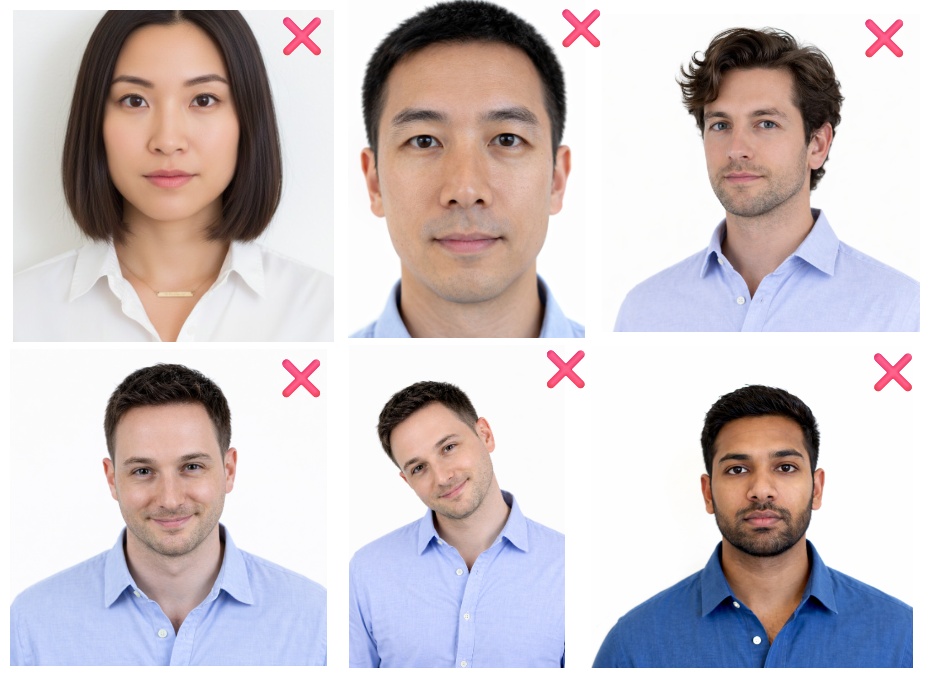
Everyone has a favorite angle, but a passport photo isn’t the place to use it. One of the most common passport photo mistakes is turning the face slightly to look more flattering. Official passport photo guidelines require a completely straight, front-facing head position.
Square your shoulders for the passport photo.
Your body should face the camera directly. Avoid twisting or angling your torso like you would in a casual portrait.
Show both sides of your face.
A correct passport photo must display your full face evenly. If more of one cheek is visible than the other, the image can be flagged as a profile view and may be rejected.
Look directly into the camera lens.
Proper passport photo positioning requires your eyes to be focused straight at the lens. Direct eye contact with the camera is essential for meeting passport photo requirements.
Why a Head Tilt Can Ruin a Passport Photo
In everyday life, most of us naturally tilt our head slightly when we talk or smile. In a passport photo, even a small tilt can cause problems.
For a compliant photo, imagine a straight line running through your eyes. That line must be perfectly level with the floor. If your head is leaning even a little to one side, the software may not be able to measure your facial features correctly.
If you’re taking a passport photo at home, it helps to have another person check that your head and eye line are completely straight.
Watch Out for the Chin Position
Chin placement is another detail that often leads to rejection.
-
Chin too high: Lifting your chin can distort your features and change the proportions of your face.
-
Chin too low: Tucking your chin can create shadows, hide your neck, and interfere with proper identification.
-
Just right: Keep your chin level, as if you are looking at a point on the wall directly in front of you.
A relaxed, neutral posture is always the safest approach.
Passport Photo Framing: Don’t Stand Too Close
Many people assume a passport photo should be a tight close-up. In reality, official passport photo requirements specify exact proportions and spacing.
Follow these basic framing rules:
-
Your head should fill roughly 70% to 80% of the photo
-
There must be visible space between the top of your head and the edge of the image
-
Your face should be centered, not leaning left or right
-
Part of your shoulders should be visible in the frame
If the top of your hair touches the edge of the photo, or your head looks too large in the image, it will likely be rejected.
Avoid Using Selfies for Passport Photos
Trying to take your own passport photo with a phone selfie is one of the biggest mistakes people make.
Selfies usually cause problems because:
-
Smartphone lenses distort facial features at close range
-
The angle of your arm creates uneven shoulders
-
It’s difficult to keep the camera perfectly level
-
Framing and proportions are often incorrect
If you plan to take your passport photo at home, place the camera on a tripod or have someone else take the picture from at least four feet away. You can crop the image later to the required size.
Quick Passport Photo Checklist
Before submitting your application, double-check these essentials:
-
Are your shoulders square to the camera?
-
Is your head perfectly straight with no tilt?
-
Are both sides of your face equally visible?
-
Are you looking directly into the lens?
-
Is there space above your head in the photo?
-
Is your expression neutral with eyes open and mouth closed?
Taking a few extra minutes to confirm these details can save you from having to redo the entire process.
Different Countries, Different Photo Dimensions
One last important point: passport photo size requirements vary by country.
For example:
-
U.S. passport photos must be 2x2 inches
-
UK and EU passport photos use different measurements and proportions
If you’re applying outside the United States, always check the exact photo dimensions required for your country before printing or uploading your image.
This document is rated 4.9 / 5 - 7 Votes