Proper Hairstyles for Passport Photos 2026 - Official Rules, Approved Styles, and Rejection-Proof Tips
Last Update: January 30, 2026
Hair placement plays a major role in whether a passport photo is accepted or rejected. In 2026, facial recognition systems require clear visibility of key facial features, making hairstyle selection an important part of the photo preparation process and overall passport photo requirements. Choosing the proper hairstyles for passport photos helps ensure your forehead, eyes, and natural facial contours are captured accurately without shadows or obstructions.
Passport Photo Hairstyle Rules
Passport photos must clearly present your natural facial structure for accurate identity verification. Hairstyle choice plays an important role in this process, as hair that obscures key facial features or alters head shape can prevent successful photo processing. Many applicants experience passport photo rejected hair issues due to improper styling, making it essential to follow approved hair guidelines.
Core Passport Photo Hair Requirements
| Requirement | Guideline |
|---|---|
| Face visibility | Entire face must be clearly visible |
| Eyes | Hair must not cover the eyes |
| Eyebrows | Eyebrows must be fully visible |
| Ears | Ears should be partially visible |
| Hair volume | Hair must not change the natural head shape |
| Shadows | Hair must not cast shadows on the face |
| Hair accessories | Only permitted for medical or religious reasons |
Best Hairstyle for Passport Photo
Choosing the correct hairstyle significantly improves your chances of having your passport photo accepted on the first submission. The safest options are styles that keep hair away from the face, maintain a natural head outline, and avoid excess volume or shadows.
-
Low Bun (Most Reliable Option)
A low bun positioned at the nape of the neck is one of the most accepted passport photo hairstyles. It keeps hair neatly away from your face while preserving the natural shape of your head. Ensure the bun is flat, smooth, and free of decorative elements.
-
Straight Hair Worn Down
Straight hair may be worn down as long as it is parted evenly and tucked behind the ears. Your eyebrows, eyes, and facial outline must remain fully visible. Avoid layers that create shadows along the cheeks or jawline.
-
Low Ponytail
A low ponytail resting behind the shoulders is another compliant option. Keep the front hair smooth and pulled away from the face. Loose strands, curls, or added volume should be avoided.
-
Short Natural Hairstyles
Short haircuts are acceptable when they clearly expose the forehead, eyebrows, and ears. Hair should be evenly shaped and should not cast shadows on the face.

Hairstyles to Avoid
Choosing the wrong hairstyle is one of the most common reasons passport photos are rejected. Even if your face is clear, certain hairstyles can cause shadows, distort head shape, or hide key facial features making your photo non-compliant.
Below are the hairstyles to avoid in passport photos.
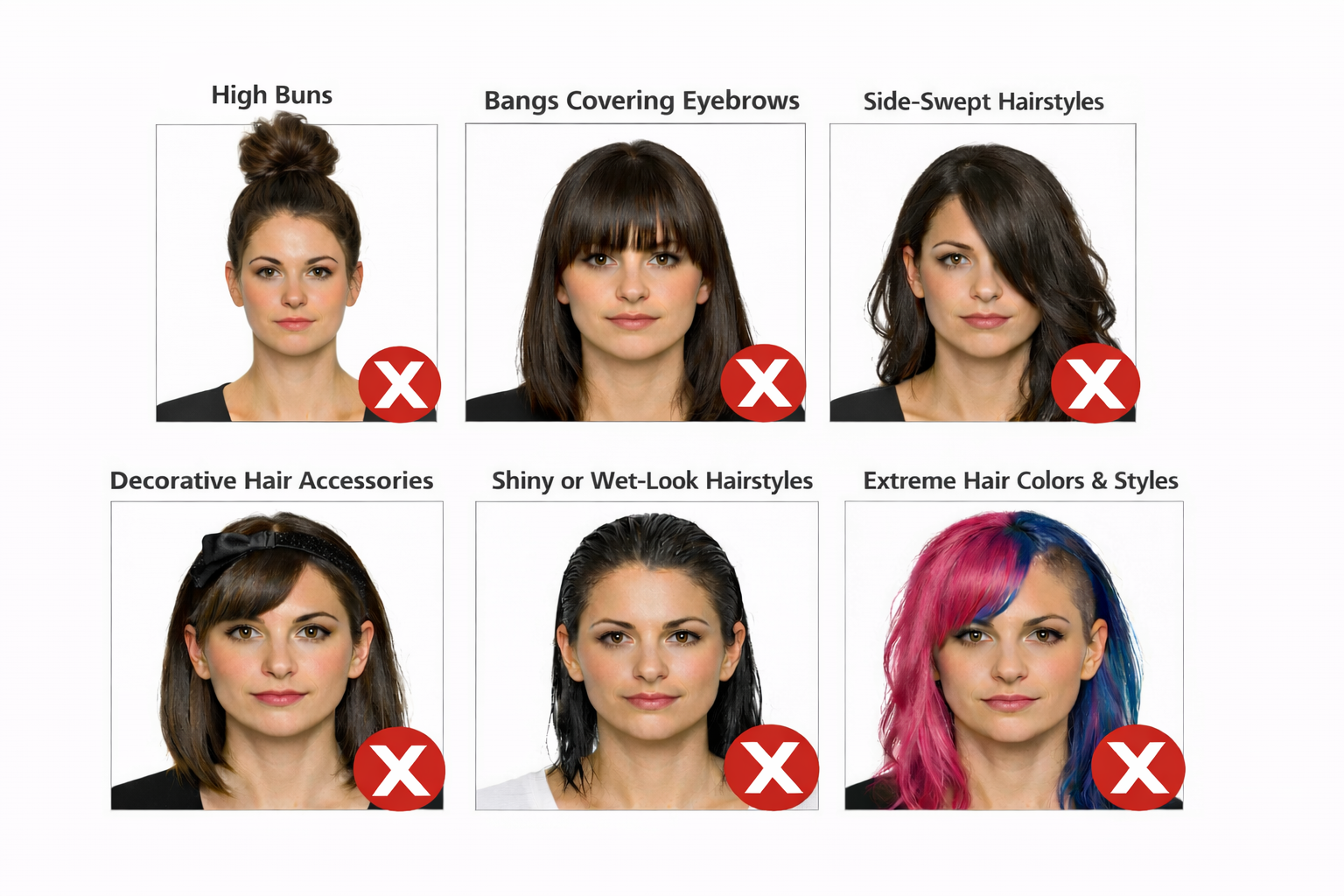
1.High Buns and Top Knots
High buns and top knots add height to the head and often cast shadows behind the head. They can distort your natural head shape and cause automatic rejection.
2.Bangs Covering Eyebrows
Passport guidelines require your eyebrows to be clearly visible. Any fringe that hides your brows may result in rejection.
3.Side-Swept Hairstyles
Hair covering one side of your face can block cheekbones, jawline, or eyebrows, which violates face visibility rules.
4.Decorative Hair Accessories
Hair accessories are not permitted in standard passport photos unless worn for verified religious or medical reasons.
5.Shiny or Wet-Look Hairstyles
Glossy products can cause glare and reflections under passport photo lighting.
6.Extreme Hair Colors & Styles
Unnatural hair colors or edgy styles may be flagged for altering your natural appearance.
Hair Accessories Rules
Hair accessories are one of the most common causes of passport photo rejection. Biometric scanning systems require a completely unobstructed facial outline, which means most accessories are not permitted.
General Rules
-
No decorative clips, barrettes, bows, or jeweled pins
-
No headbands or fashion hairbands
-
No visible bobby pins unless absolutely necessary to hold hair back
-
No flowers, ribbons, or novelty accessories
-
No hats or caps (except for religious reasons)
Final Tips
-
Keep your hairstyle simple and natural for passport photos
-
Make sure eyes, eyebrows, cheeks, and jawline are fully visible
-
Tie long hair in a low ponytail or low bun
-
Avoid high buns, heavy volume, and stiff hair products
-
Remove all visible hair accessories and headbands
-
Religious head coverings are allowed if the full face is clearly visible
-
When in doubt, choose the most minimal, biometric-friendly hairstyle
FAQ
What is the best hairstyle for a passport photo in 2026?
The best hairstyle is a simple, natural style that keeps the full face visible. Low ponytails, low buns, and neatly worn-down hair tucked behind the ears have the highest approval rate.
Can I wear my hair down in a passport photo?
Yes. Hair can be worn down as long as it does not cover your eyes, eyebrows, cheeks, or jawline and does not cast shadows on your face.
Are bangs allowed in passport photos?
Light bangs are allowed only if your eyebrows and eyes remain fully visible. Heavy fringe that covers the forehead or eyebrows often leads to rejection.
Are hair accessories allowed?
Decorative accessories such as clips, bows, headbands, and jeweled pins are not allowed. Only hidden pins or plain elastic hair ties may be used to keep hair in place.
Are religious head coverings like hijab or turban allowed?
Yes. Religious head coverings are permitted if the full face from chin to forehead is clearly visible and the fabric does not cast shadows on the face.
Can I wear a high bun or top knot?
High buns and top knots are not recommended because they can distort head shape and interfere with biometric facial recognition.
Can curly or coily hair be worn naturally?
Yes. Curly and coily hair are allowed as long as the face remains fully visible and the hair does not cover facial features.
Why do passport photos get rejected for hair reasons?
Photos are rejected when hair blocks facial landmarks, changes head shape, casts shadows, or includes visible accessories, which interferes with biometric scanning.
This document is rated 5 / 5 - 4 Votes